What the GCC is and why travelling inside it is easy
Travel between Gulf countries has become one of the easiest regional trips in the world for people who live in the region. The six GCC states share a common market, a narrow time-zone band (UTC+3 and UTC+4), currencies pegged to the US dollar that make budgeting predictable, and dense flight schedules that put every capital within about two hours of Dubai. This GCC travel guide covers the practical side: who needs which document, how long each hop takes, what a week realistically costs, when to go, and a day-by-day 7-day itinerary you can copy.
Gulf travellers plan differently from long-haul tourists: trips are shorter (often a weekend or a long weekend around Eid), decisions are made late, and the same route is repeated several times a year. That pattern rewards learning the rules once and reusing them — which is exactly what the comparison tables below are designed for.
The six GCC countries compared
The comparison table below summarises the essentials for each GCC country as of early 2026. Currency pegs are fixed against the US dollar, so exchange rates barely move; entry rules, however, do change, so the residency column is deliberately conservative — treat it as a starting point and confirm on the official portal linked in the sources before you travel.
| Country | Currency (USD peg) | Time zone | GCC citizens | GCC residents | Main airports | Best months |
|---|---|---|---|---|---|---|
| Saudi Arabia | Saudi riyal (SAR) — 3.75 per USD | UTC+3 | National ID card, no visa | Tourist eVisa via Visit Saudi for eligible residents — check portal | RUH Riyadh, JED Jeddah, DMM Dammam | Nov–Mar |
| United Arab Emirates | UAE dirham (AED) — 3.6725 per USD | UTC+4 | National ID card, no visa | Entry permit / visa on arrival for eligible professions — check ICP | DXB Dubai, AUH Abu Dhabi, SHJ Sharjah | Nov–Apr |
| Qatar | Qatari riyal (QAR) — 3.64 per USD | UTC+3 | National ID card, no visa | Visa on arrival / eVisa for eligible professions — check Hayya | DOH Doha Hamad | Nov–Mar |
| Kuwait | Kuwaiti dinar (KWD) — approx. 0.31 per USD (1 KWD ≈ USD 3.25) | UTC+3 | National ID card, no visa | eVisa for eligible professions — check Kuwait Visa (MOI) | KWI Kuwait | Nov–Mar |
| Bahrain | Bahraini dinar (BHD) — 0.376 per USD | UTC+3 | National ID card, no visa | Visa on arrival / eVisa for eligible residents — check evisa.gov.bh | BAH Bahrain | Nov–Mar |
| Oman | Omani rial (OMR) — 0.385 per USD | UTC+4 | National ID card, no visa | Visa on arrival / eVisa for eligible residents — check ROP portal | MCT Muscat, SLL Salalah | Oct–Mar (Salalah: Jun–Aug khareef) |
Entry rules for GCC citizens
GCC citizens — nationals of Saudi Arabia, the UAE, Qatar, Kuwait, Bahrain and Oman — can enter any other member state with a valid national ID card and do not need a visa. Children need their own ID card or a passport, and some airlines still ask for a passport on international flights, so carrying both documents is the safest habit. The King Fahd Causeway, the Saudi–UAE crossing at Al Batha and the Saudi–Qatar crossing at Salwa all accept the national ID card for GCC nationals.
Entry rules for GCC residents (expats)
GCC residents who are not citizens — the expatriate workforce holding an Iqama, Emirates ID, Qatar ID or equivalent — do not enjoy automatic free movement, but every GCC country offers them a lighter visa route than ordinary tourists. That route is usually an eVisa or a visa on arrival, granted on the basis of a valid residency permit (often with at least three to six months remaining) and, in several countries, an eligible profession printed on the permit.
- Saudi Arabia: GCC residents can apply for the tourist eVisa through the Visit Saudi portal; a residency permit valid for at least three months is generally required (approx. — check the portal for the current rule).
- UAE: GCC residents in eligible professions apply for an entry permit online through the ICP or GDRFA channels before travelling; some categories may still be granted a visa on arrival — confirm your category with your airline.
- Qatar: GCC residents in eligible professions have historically been able to obtain a visa on arrival for a small fee; other visitors use the Hayya platform.
- Kuwait: GCC residents in eligible professions can apply for an eVisa through the Ministry of Interior's Kuwait Visa platform, relaunched in 2024.
- Bahrain: most GCC residents qualify for a visa on arrival or a quick eVisa through evisa.gov.bh.
- Oman: GCC residents in eligible professions can obtain a visa on arrival or an eVisa through the Royal Oman Police portal.
The unified GCC tourist visa
The unified GCC tourist visa — often compared to Europe's Schengen visa and promoted under the ‘GCC Grand Tours’ initiative — was approved by GCC interior ministers in 2023 to let visitors move between all six countries on a single permit. As of early 2026 the scheme is being rolled out in stages, and details such as fees, eligible nationalities and whether residents can use it are still being finalised. Check the GCC Secretariat and national portals for the current status rather than assuming the unified visa is available for your trip.
Flying between Gulf countries: times, airlines and schedules
Flights are how most travel between Gulf countries happens: the region's hubs are all within roughly one to three hours of each other, and Dubai alone has more than a dozen daily departures to Riyadh, Kuwait and Doha. The flight-time table lists approximate block times and the carriers that typically fly each route; frequencies shift by season and by day of the week, so treat them as a planning guide rather than a timetable.
| Route | Approx. flight time | Typical airlines | Daily flights (approx.) |
|---|---|---|---|
| Riyadh (RUH) – Dubai (DXB) | 1 h 50 min | Saudia, flynas, flyadeal, Emirates, flydubai | 15+ |
| Jeddah (JED) – Dubai (DXB) | 3 h | Saudia, flynas, Emirates, flydubai | 10+ |
| Kuwait (KWI) – Dubai (DXB) | 1 h 40 min | Kuwait Airways, Jazeera Airways, Emirates, flydubai | 10+ |
| Doha (DOH) – Dubai (DXB) | 1 h 10 min | Qatar Airways, Emirates, flydubai | 10+ |
| Bahrain (BAH) – Dubai (DXB) | 1 h 10 min | Gulf Air, Emirates, flydubai | 8+ |
| Muscat (MCT) – Dubai (DXB) | 1 h 05 min | Oman Air, Emirates, flydubai, SalamAir | 8+ |
| Riyadh (RUH) – Doha (DOH) | 1 h 20 min | Qatar Airways, Saudia, flynas | 6+ |
| Riyadh (RUH) – Kuwait (KWI) | 1 h 30 min | Kuwait Airways, Jazeera Airways, Saudia, flynas | 5+ |
| Riyadh (RUH) – Bahrain (BAH) | 1 h 05 min | Gulf Air, Saudia, flynas | 5+ |
| Riyadh (RUH) – Muscat (MCT) | 2 h 10 min | Oman Air, Saudia, SalamAir, flynas | 3+ |
Full-service vs low-cost carriers
Full-service carriers — Emirates, Qatar Airways, Saudia, Etihad, Gulf Air, Kuwait Airways and Oman Air — include checked baggage, a meal and seat selection in most fares and operate from the main terminals. Low-cost carriers — flydubai, flynas, flyadeal, Air Arabia, Jazeera Airways and SalamAir — sell a seat-only fare and charge separately for bags, meals and seats, which makes them approx. 30–50% cheaper for a weekend trip with hand luggage only. On a two-hour Gulf hop the cabin difference matters little; the baggage policy and the airport (Sharjah or Dubai World Central instead of DXB, for example) matter more.
Five booking rules that save money on Gulf flights
- Book intra-GCC flights 3–6 weeks ahead for normal travel dates and 8–10 weeks ahead for Eid, national days and school holidays, when fares can double.
- Compare the low-cost carrier's fare with bags added against the full-service fare — the gap often shrinks to a few dollars once a 20 kg bag is included.
- Fly on Tuesday, Wednesday or Saturday; Thursday evening and Sunday departures carry the weekend premium across the Gulf.
- Check secondary airports: Sharjah (SHJ) and Dubai World Central (DWC) for Dubai, Dammam (DMM) for the Saudi Eastern Province and Bahrain, and Ras Al Khaimah (RKT) for the northern emirates.
- Use the airline's own app for the final booking — GCC carriers frequently run app-only promo codes and charge lower payment fees than third-party agencies.
For a route-specific deep dive, read how to book the cheapest flights from Riyadh to Dubai, which compares the six airlines on the Gulf's busiest route and shows the booking windows that actually lower the fare.
Driving and land border crossings
Driving between GCC countries is popular with families and groups, with the Saudi–Bahrain causeway and the UAE–Oman crossings the busiest. Land borders are modern and generally quick outside holiday peaks, but the desert distances are real: Riyadh to Dubai is a full day behind the wheel with long stretches between fuel stations.
| Route | Border crossing | Approx. distance | Approx. driving time | Notes |
|---|---|---|---|---|
| Riyadh – Manama (Bahrain) | King Fahd Causeway (approx. 25 km bridge) via Dammam / Al Khobar | approx. 450 km | 5–6 h | Causeway toll; heavy queues Thursday evenings and Eid |
| Riyadh – Doha | Salwa (Saudi) / Abu Samra (Qatar) | approx. 570 km | 6–7 h | Reopened in 2021; fuel up in Al Ahsa |
| Riyadh – Dubai | Al Batha (Saudi) / Al Ghuwaifat (UAE) | approx. 1,000 km | 10–12 h | Long desert stretches; consider an overnight stop |
| Kuwait City – Riyadh | Al Nuwaiseeb (Kuwait) / Al Ruqi (Saudi) | approx. 600 km | 6–7 h | Straight highway; busy around Eid |
| Dubai – Muscat | Hatta (UAE) / Al Wajajah (Oman) | approx. 450 km | 4.5–5.5 h | Scenic mountain route; check Oman car-insurance rules |
| Dubai – Abu Dhabi | None (domestic) | approx. 140 km | 1.5 h | E11 highway; E100/E101 buses approx. AED 25 |
Documents for driving across GCC borders
- Vehicle registration (mulkiya / istimara) in the driver's name, or a notarised authorisation letter if you are not the registered owner — a rental car needs the rental company's written cross-border permission.
- Insurance valid in the destination country: most Gulf policies stop at the border, so buy a short-term extension or the ‘Orange Card’ (unified Arab insurance card) before you leave.
- National ID cards for every GCC citizen in the car and passports plus valid residency permits and visas for residents.
- Cash or card for tolls and fees: the King Fahd Causeway toll and any exit fees are charged per vehicle; several crossings accept cards, but small notes speed things up.
- Vehicle inspection readiness: borders check tints, plates and sometimes dash cams; remove anything that is illegal in the destination country.
Trains and buses between Gulf countries
Rail
Rail travel between GCC countries does not yet exist as a cross-border service, but the pieces are arriving. Inside the UAE, Etihad Rail's passenger service connecting Abu Dhabi, Dubai and the northern emirates has been announced for 2026 — as of early 2026, check the operator for the current timetable and fares. Inside Saudi Arabia, the Haramain high-speed train links Makkah, Jeddah and Madinah, and the Riyadh Metro opened in late 2024. The wider GCC Railway, a network planned to connect all six states from Kuwait to Muscat, is targeted for around 2030 and remains under construction.
Buses
Bus travel between Gulf countries is limited but cheap. Saudi Arabia's SAPTCO has operated international coaches to Bahrain, Qatar and the UAE at various times, and private operators run Dubai–Muscat services; schedules change often and many routes were reshaped after 2020, so book only through the operator's official site or app and confirm the border-crossing procedure for your nationality. Expect approx. 6–7 hours Dammam–Doha and 6–8 hours Dubai–Muscat including border formalities, for fares of approx. USD 20–60.
How much travel between Gulf countries costs
Costs for travel between Gulf countries vary less by country than by travel style: Dubai and Doha hotels are the most expensive at peak season, Manama and Muscat are gentler on the wallet, and Riyadh sits in between, with prices rising sharply during Riyadh Season events. The cost table shows realistic per-person ranges as of early 2026, excluding shopping.
| Expense | Budget | Mid-range | Luxury |
|---|---|---|---|
| One-way flight between hubs | USD 60–120 (low-cost, booked early) | USD 120–250 | USD 300–700 (business class) |
| Hotel per night | USD 45–90 | USD 100–220 | USD 300–1,000+ |
| Food per day | USD 15–30 | USD 40–80 | USD 120+ |
| Local transport per day | USD 5–15 (metro, buses) | USD 20–50 (taxis, ride-hailing) | USD 80+ (car with driver) |
| Connectivity for one week | USD 5–15 (regional eSIM) | USD 15–30 (larger eSIM plan) | USD 50–150 (home-operator roaming) |
| Attractions per day | USD 0–20 | USD 30–70 | USD 100+ |
Put together, a mid-range traveller should plan on approx. USD 130–250 per day for hotel, food, local transport and one paid attraction — approx. USD 900–1,750 for a 7-day trip before flights. A budget traveller sharing a room can bring that down to approx. USD 70–110 per day, while a luxury itinerary starts around USD 400 per day. Shopping, desert safaris and fine dining are the usual budget breakers, not the basics.
Roaming vs a regional eSIM
Roaming is the quiet budget-killer on Gulf trips: home-operator daily roaming passes typically cost approx. USD 7–20 per day, so a week across three countries can add USD 50–150 to the phone bill. A regional travel eSIM covering the whole Middle East costs a fraction of that, installs by QR code before you leave home and switches networks automatically at each border. FlashSim's Middle East eSIM plans cover all six GCC states on one plan, and single-country plans for Saudi Arabia, the UAE, Qatar, Kuwait, Bahrain and Oman suit one-country trips.
One eSIM for all six Gulf states
Land connected in Riyadh, Dubai, Doha or Muscat with a regional Middle East data plan — instant QR delivery, no roaming surprises.
When to travel: weather, Ramadan and festival season
Weather sets the rhythm of Gulf travel. From November to March, daytime highs across the six GCC countries sit around 20–28 °C with cool evenings, which is when outdoor festivals, desert camps and beach days happen. From June to September, highs of 42–48 °C push life indoors, hotel prices fall by approx. 30–50%, and the only comfortable outdoor destination is Salalah in southern Oman during its khareef monsoon season.
Religious calendar 2026 (approximate dates)
- Ramadan 2026 is expected to run from approx. mid-February to mid-March 2026. Restaurants open late, malls stay open past midnight, and daytime dining is limited outside hotels — a special, quieter time to visit, but not for food-focused trips.
- Eid al-Fitr 2026 falls around 20 March 2026 (approx., subject to moon sighting). Flights and hotels across the GCC sell out weeks ahead and fares can double; book by early February.
- Eid al-Adha 2026 falls around late May 2026 (approx.). Temperatures are already high, so Eid al-Adha trips lean towards indoor Dubai, Doha and Riyadh attractions or Salalah.
- Islamic dates move about 11 days earlier each year and are confirmed by moon sighting, so check the official calendar of the country you are visiting before fixing dates.
Festivals and seasons worth planning around
- Riyadh Season (approx. October–March): concerts, Boulevard City and sports events — hotel prices in Riyadh rise 30–60% on big weekends.
- Dubai Shopping Festival (approx. December–January): mall promotions, fireworks and raffles; peak hotel season in Dubai.
- Muscat Nights / Muscat Festival (approx. January–February) and the Salalah khareef season (approx. June–August) in Oman.
- Formula 1: the Bahrain Grand Prix in spring, the Qatar Grand Prix and the Abu Dhabi Grand Prix in late November–December — race weekends fill hotels within a 100 km radius.
- National days: Saudi (23 September), Qatar (18 December), UAE (2 December), Kuwait (25–26 February), Bahrain (16 December), Oman (18 November) — long weekends with fireworks and domestic travel spikes.
A 7-day GCC itinerary: Riyadh to Muscat
The 7-day itinerary below strings the Gulf's most visited cities into one week, moving east from Riyadh to Muscat with short hops and no backtracking. Costs are approximate per person for a mid-range traveller and exclude the flights between cities — budget approx. USD 350–600 for the four hops if booked three weeks ahead. Swap Abu Dhabi for a second Dubai day if you prefer a slower pace.
Day 1: Riyadh — heritage and skyline
Day 1 · Riyadh
- 09:00Diriyah — At-Turaif UNESCO districtapprox. SAR 0–50
Restored mud-brick birthplace of the Saudi state; book a timed slot online.
- 12:30Lunch at Bujairi Terraceapprox. SAR 80–150
Saudi and international restaurants overlooking At-Turaif.
- 15:00National Museum of Saudi Arabiaapprox. SAR 10
Eight galleries from pre-history to the modern kingdom.
- 18:00Kingdom Centre Sky Bridgeapprox. SAR 69
Sunset over the capital from 300 m.
- 20:30Boulevard Riyadh City (Riyadh Season, Oct–Mar)varies
Restaurants, shows and fountains; outside the season, choose Al Olaya cafés instead.
Day 2: Riyadh to Manama — forts, museums and Adliya
Day 2 · Riyadh → Manama
- 08:00Fly RUH–BAH (approx. 1 h 05 min) or drive via the King Fahd Causewayapprox. USD 90–180 flight
Driving takes 5–6 hours including the causeway.
- 12:00Bahrain National Museumapprox. BHD 1
Dilmun civilisation, pearl diving and traditional crafts.
- 14:00Lunch in Block 338, Adliyaapprox. BHD 6–12
Bahrain's restaurant and gallery quarter.
- 16:00Qal'at al-Bahrain (UNESCO fort)free
Sunset over the fort and the sea; small site museum.
- 19:00Manama Souq and Bab Al Bahrainfree
Spices, gold, halwa and pearl shops.
Day 3: Doha — museums, souq and the Corniche
Day 3 · Manama → Doha
- 08:30Fly BAH–DOH (approx. 1 h)approx. USD 90–200
Gulf Air and Qatar Airways both fly the route several times a day.
- 11:00Museum of Islamic Artapprox. QAR 50 (discounts for residents)
I. M. Pei's landmark on its own island in Doha Bay.
- 14:00Lunch at Souq Waqifapprox. QAR 40–80
Karak tea, machboos and the falcon souq.
- 16:30Katara Cultural Village and beachfree
Amphitheatre, mosques and galleries.
- 19:00Corniche walk and dhow cruiseapprox. QAR 50–100
Skyline views of West Bay after dark.
Day 4: Doha to Dubai — old Dubai and the Burj Khalifa
Day 4 · Doha → Dubai
- 09:00Fly DOH–DXB (approx. 1 h 10 min)approx. USD 90–200
One of the Gulf's busiest routes, 10+ daily flights.
- 12:00Al Fahidi Historical District and abra crossingapprox. AED 1 abra
Wind-tower houses, then a one-dirham abra across Dubai Creek.
- 14:00Gold Souk and Spice Souk lunchapprox. AED 40–80
Deira's traditional markets.
- 17:00Dubai Mall and Burj Khalifa At the Top (sunset slot)approx. AED 169–250
Book the sunset slot a week ahead.
- 20:00Dubai Fountain and dinner at Souk Al Baharapprox. AED 120–200
Check the fountain show schedule on the day.
Day 5: Dubai — future, beach and marina
Day 5 · Dubai
- 09:00Museum of the Futureapprox. AED 149
Timed tickets sell out; book online.
- 12:00Jumeirah Mosque tour, then La Mer / J1 Beachfree – approx. AED 35
Mosque tours run most mornings.
- 15:00Palm Jumeirah and The View at The Palmapprox. AED 100
Take the Palm Monorail for the views.
- 18:00Dubai Marina walk and dinnerapprox. AED 100–180
Marina Walk or JBR The Beach.
- Alt.Afternoon desert safari instead of the Palmapprox. AED 150–350
Dune drive, camel ride and BBQ dinner.
Dubai deserves more than two days if your schedule allows it; the dedicated 3 Days in Dubai itinerary expands these stops with timings, costs and neighbourhood tips written for travellers arriving from other Gulf countries.
Day 6: Abu Dhabi day trip — mosque, Louvre and the palace
Day 6 · Dubai → Abu Dhabi → Dubai
- 07:30Drive or take the E100/E101 bus Dubai–Abu Dhabi (approx. 1.5 h)approx. AED 25 bus / AED 250 taxi
Bus fare is paid with a Nol card.
- 09:30Sheikh Zayed Grand Mosquefree
Modest dress required; free abayas available.
- 12:00Louvre Abu Dhabiapprox. AED 63
Allow two hours; lunch at the museum café.
- 15:00Qasr Al Watan presidential palaceapprox. AED 65
Or the Corniche beach if you prefer sea air.
- 18:30Return to Dubaias above
Traffic on the E11 peaks 17:00–19:00.
Day 7: Muscat — the calm finale
Day 7 · Dubai → Muscat
- 08:00Fly DXB–MCT (approx. 1 h 05 min)approx. USD 80–170
Or drive the scenic Hatta–Al Wajajah route (approx. 5 h).
- 11:00Sultan Qaboos Grand Mosquefree
Open to visitors Saturday–Thursday mornings; modest dress.
- 13:00Mutrah Souq and Corniche lunchapprox. OMR 4–8
Frankincense, silver and shuwa.
- 15:30Royal Opera House Muscat and Qurum Beachfree – approx. OMR 3
Guided tours of the opera house run on set days.
- 18:00Al Alam Palace, Muscat Gate and the old town at sunsetfree
Then a late flight home — Muscat–Riyadh is approx. 2 h 10 min.
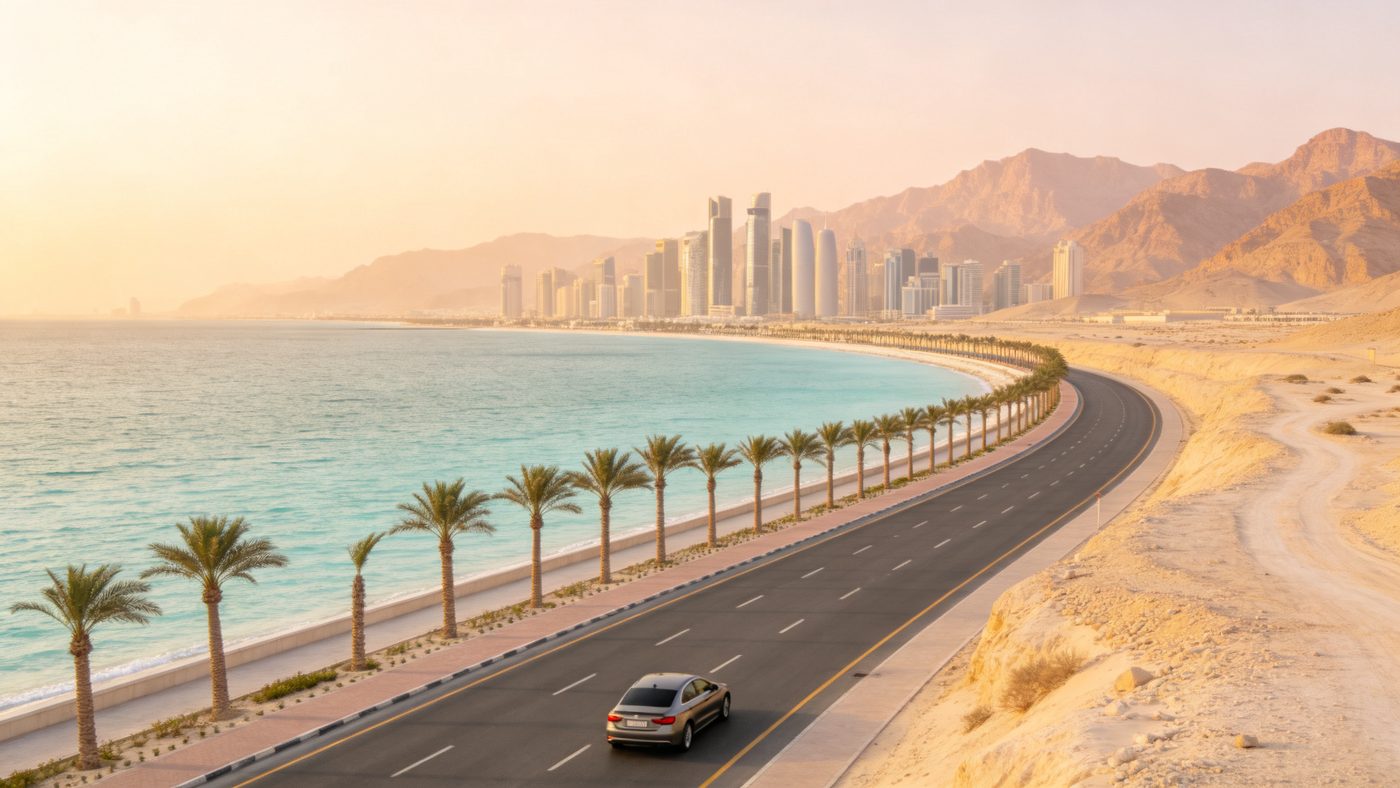
The full 7-day GCC itinerary costs approx. USD 1,300–2,300 per person on a mid-range budget including inter-city flights, hotels, food, local transport and the attractions listed — roughly the price of one long-haul holiday, spread across five cities and four countries.
Etiquette, packing and practical tips
- Dress modestly in public spaces across the GCC: shoulders and knees covered is the safe baseline; beaches and hotel pools are more relaxed, and mosques require full coverage and a headscarf for women.
- Friday is the holy day: government offices close, many shops open only after the afternoon prayer, and traffic is lightest on Friday mornings — ideal for road trips and photography.
- Public displays of affection, alcohol outside licensed venues and photographing people without permission can cause problems in every GCC country; rules on alcohol differ sharply between the UAE and Bahrain (licensed venues) and Saudi Arabia and Kuwait (prohibited).
- Greetings matter: a handshake between men is normal; wait for a woman to offer her hand first, and accept coffee or dates when offered — refusing outright can seem cold.
- Ramadan etiquette: do not eat, drink or smoke in public during daylight hours; many hotels serve meals discreetly to non-fasting guests.
- Tipping is appreciated but not obligatory: approx. 10% in restaurants that do not add a service charge, and small notes for porters and valets.
- Documents: national ID card and passport for citizens; passport, residency permit and printed visa approval for residents — plus digital copies in cloud storage.
- Power: the UK-style Type G plug is standard across the GCC (some older Saudi buildings use Type A/C), so one Type G adapter covers the whole trip.
- Clothing: light layers for air-conditioned malls and cool winter evenings; a light scarf or shawl doubles as mosque cover.
- Health: sunscreen and a refillable bottle year-round; pharmacies are excellent and most medicines are available, but bring prescriptions for controlled medications.
- Payments: cards and Apple Pay are accepted almost everywhere; carry approx. USD 50 in local cash per country for souqs, abras and tips.
- Connectivity: install a regional eSIM before departure and download offline maps of each city — signal is excellent in cities and thinner on desert highways.
Staying connected across the Gulf
Mobile data is the tool that holds a multi-country Gulf trip together: eVisa confirmations live in email, border officers scan QR codes from your phone, ride-hailing apps replace taxi ranks, and family expects a video call from every new city. Buying a local SIM in each country means a passport registration queue at every airport; roaming means an unpredictable bill. A travel eSIM avoids both.
- Check that your phone is eSIM-compatible and carrier-unlocked (most iPhones from the XS onwards and recent Samsung and Google devices are).
- Choose a regional Middle East plan if you are visiting two or more GCC countries, or a single-country plan for one destination.
- Install the eSIM by QR code while still on home Wi-Fi, but leave data roaming for that line off until you land.
- Keep your home SIM active for calls and banking one-time passwords, and route data through the travel eSIM.
- Top up in the app if a data-heavy week runs the plan down — no new QR code needed.
FlashSim sells prepaid travel eSIMs for more than 200 destinations, including every GCC state and a regional Middle East plan, with instant QR delivery and validity that starts when you land rather than when you buy. Browse all destinations to compare plans by data allowance and validity before your next Gulf trip.
Ready for your Gulf trip?
Compare eSIM plans for every GCC country and 200+ other destinations — buy in minutes, activate by QR code.